
How did I get to this?
So, I’ve started a blog. I embark on another adventure into the unknown. But if I only limit myself to what I already do, then I will not achieve much.
I am an artist. I’m not an amazing, groundbreaking one. I create for myself. It is a therapy. I hate selling my work. I really hate selling it. But I’m okay talking about it.
When I moved in with my future husband in December 2003, he offered to look after the finances while I pursued my dream of becoming an artist and giving up teaching art for a living. I embraced the opportunity; setting up my website and working on commissions. But I realised quickly that, although creating commissions for others was reasonably okay, selling a piece of work I had spent months working on for less than the minimum wage to create was not what I had planned. I was not a salesperson either. My head isn’t up my arse, so I struggle to convince people to buy my work, especially when I don’t want them to have it anyway. It was a poor business model.
Two children and a 21-year teaching career later, I never realised my dream and my studio was filled with paddling pools and bikes.
After the pandemic, I moved my whole family to live with my disabled and elderly mother in 2021. I couldn’t get a new job in teaching because I was too expensive and opinionated, so I started renovating my mother’s house for her. Then she got terminal cancer.
I still believe the seed of the idea to upend my family’s lives and look after my mother was planted by interfering gods or my late grandmother, whoever knew I needed to be here for her. I couldn’t get a job because of the need for weekly appointments, so I set up another art studio and tried to get back into dream-pursuing while caring for her needs.
I kept her alive for three years longer than her initial prognosis determined. It was the best decision I ever made. We ranted about the world towards every hospital appointment. We contemplated the world on every trip back, if she had the energy. My mother was a highly intelligent and enthusiastic woman. I may have been looking after her body, but she was looking after my mind.
She sadly died in March 2026, surrounded by loving family rather than on her own in a dilapidated old house. She died on my birthday, two days before Mother’s Day. I am now missing someone to rant and contemplate with, so whoever is reading this, I have chosen you. I hope you are as sane, wise, and enthusiastic as she was.
I want to write about a sculpture I made recently. I am over 50 years old, so am in the middle or end of perimenopause. My symptoms started about 10 years ago and they have been cruel. I have lost physical and mental strength, clarity, a grip on my emotions, and my calm/placid disposition. I have gained weight, rage, itchy skin, and insight into the functionality of the female body. I recently signed up with a teaching supply agency to get myself back into work, but after seven days of it I have reached the conclusion that a grip on emotions is very much needed in the teaching profession.
So at the most insecure moment of my entire life, I made a maquette representing how I feel. I started with a polystyrene ball and self-drying clay formed around it to form a body. This idea came to me in bed: what happens when you take the polystyrene away? A void would be left behind. As my fertility function has now passed, there is this overwhelming sense of voidness in my abdomen. The absence of potential pregnancies is a physical void.
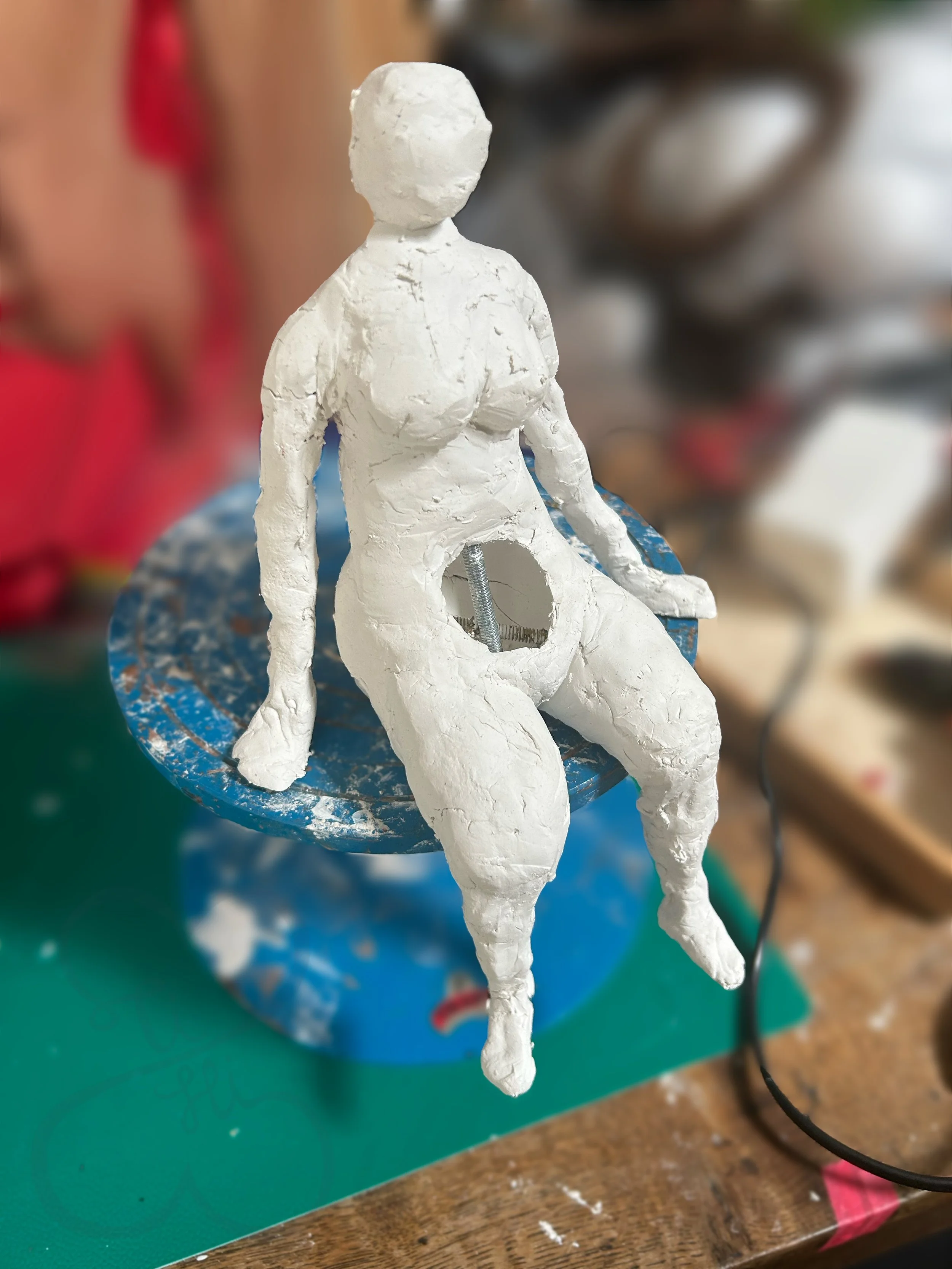
The sculpture didn’t quite work as air-drying clay is a ball-ache to work with, and I had forgotten that the supports would still be visible when I melted to polystyrene ball away with a heat gun. I was out of practice. However, it had only taken a couple of hours to make, so I set about making a bigger and better version. I am so glad I’m a glass half full kind of person still - that part of me was embedded before hormones took over.
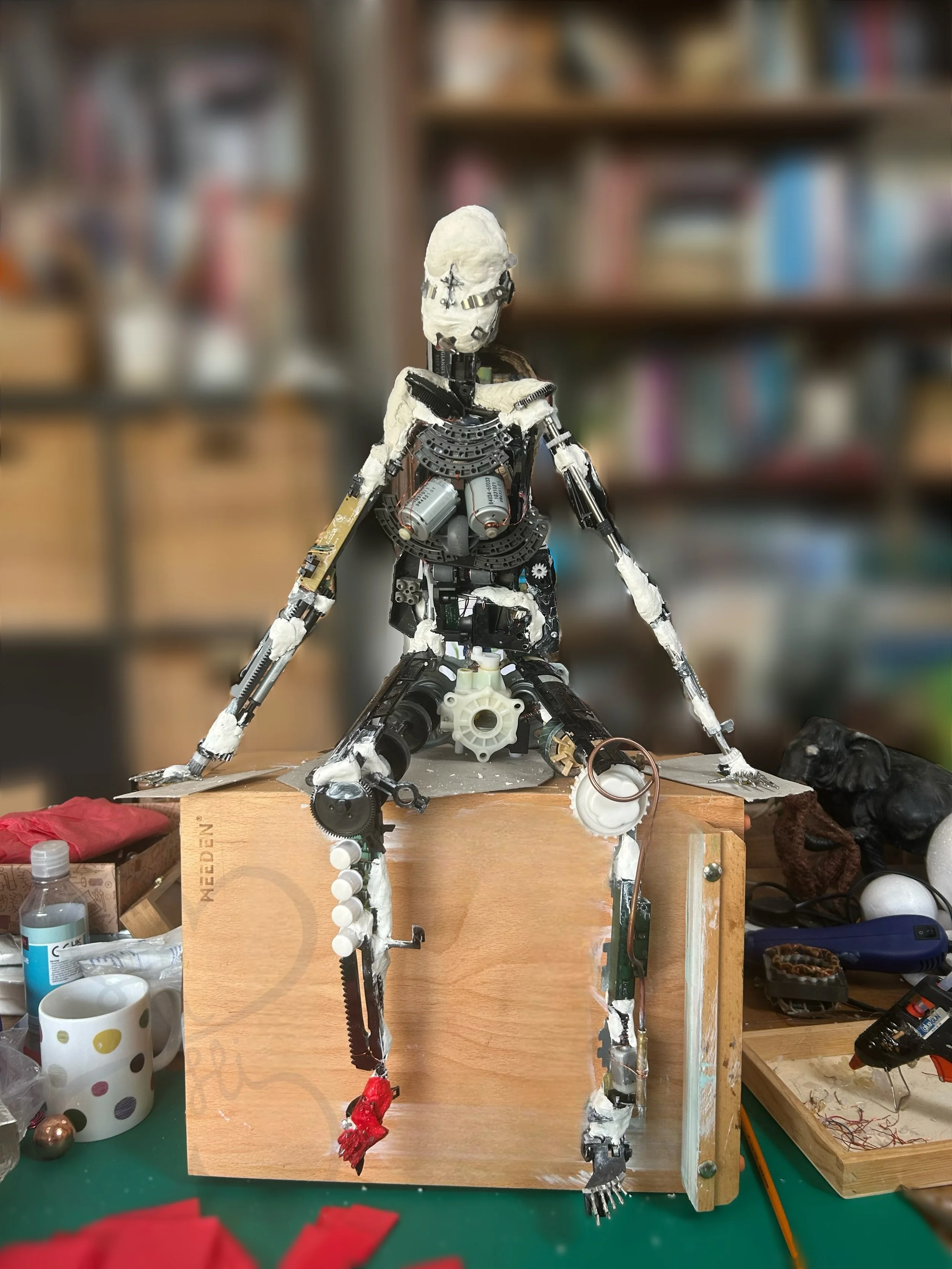
I have long collected small mechanical and electrical parts - breaking apart a broken printer that has given you nothing but intermittent success and stress is very satisfying. I used these parts to create a figurative sculpture representing a woman.
There is a thrill in looking at a random electrical component which you do not understand, and placing it perfectly to represent a dodgy knee. Some would spend hours perfecting a pencil line to represent the swollen lymph and grating bones. I used a small piece of copper tubing that elegantly but awkwardly showed how an old knee can lock out of position with no warning or even movement.
I am impatient. I did not have time to solder every component. Some components wouldn’t solder. So I took my trusted glue gun and some fine copper wire to attach everything together. I then used self-drying clay to add a little flesh to hide the glue and give it a little organic form. I was not creating a robot.
This woman I created represented how I felt: my aging parts look asymmetrical, worn out, damaged, pointless, disconnected, rusty, formulaic, dysfunctional and locked into position. I was thrilled with the way she looked. I imagined her sitting on the edge of a shelf, like feet dangling over the edge of a wall when I was a child, before hormones took over.
She doesn’t look pissed off or knackered. Her tension is held captive in her bones, too frightened to be released in case it causes complete collapse. She’s just contemplative.
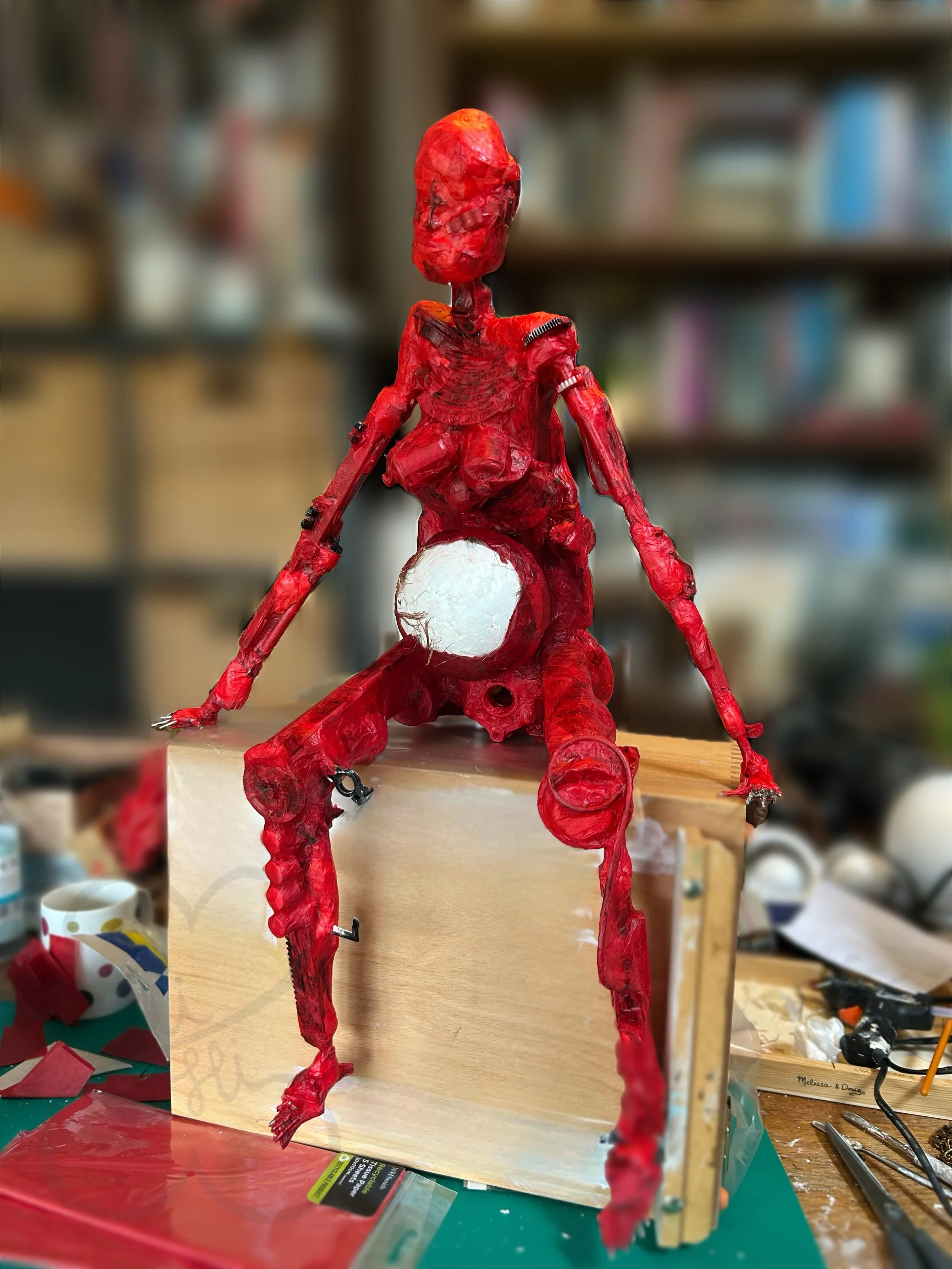
I took a few photos but immediately wanted to cover her in red tissue paper. I love papier mâché. It is a therapeutic process. You make really sloppy wallpaper paste; add a bit of PVA for strength, and then soak bits of vivid red tissue paper wherever you want it to go. The more paste you brush on, the more compliant the paper becomes. The paste also made the tissue paper look like blood and flesh. It was an enjoyable process.
I placed a large polystyrene ball where her pregnancies once were. I wrapped the ball in copper wire to represent all those redundant veins and arteries that once supported life. The red tissue paper brought her all together in one fleshy piece.
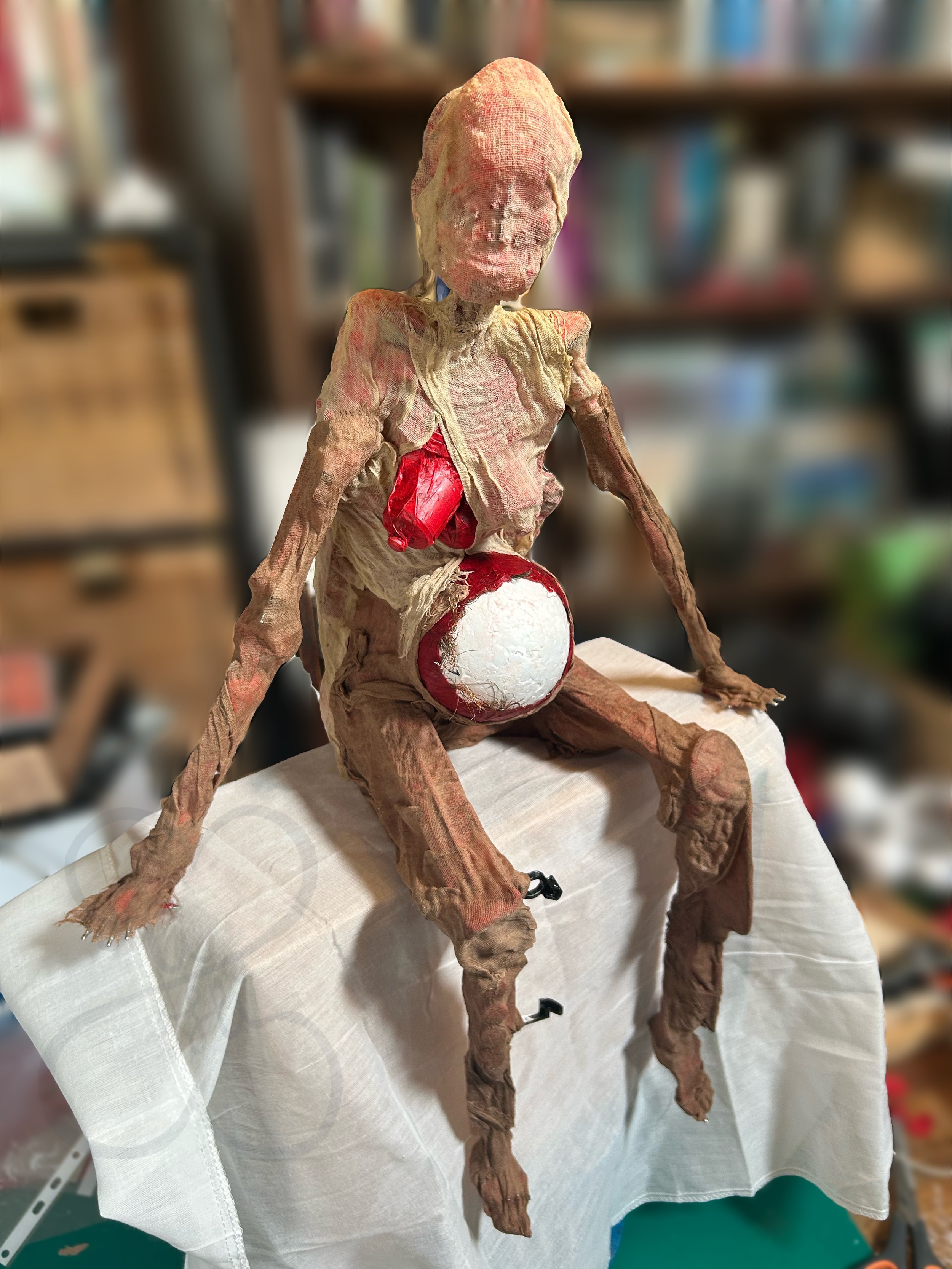
When she was covered in red, she looked quite sinister. I thought she needed a skin. I took some old muslin cloth that my mother had used for her jam-making, soaked it in paste and wrapped it around her vivid flesh.
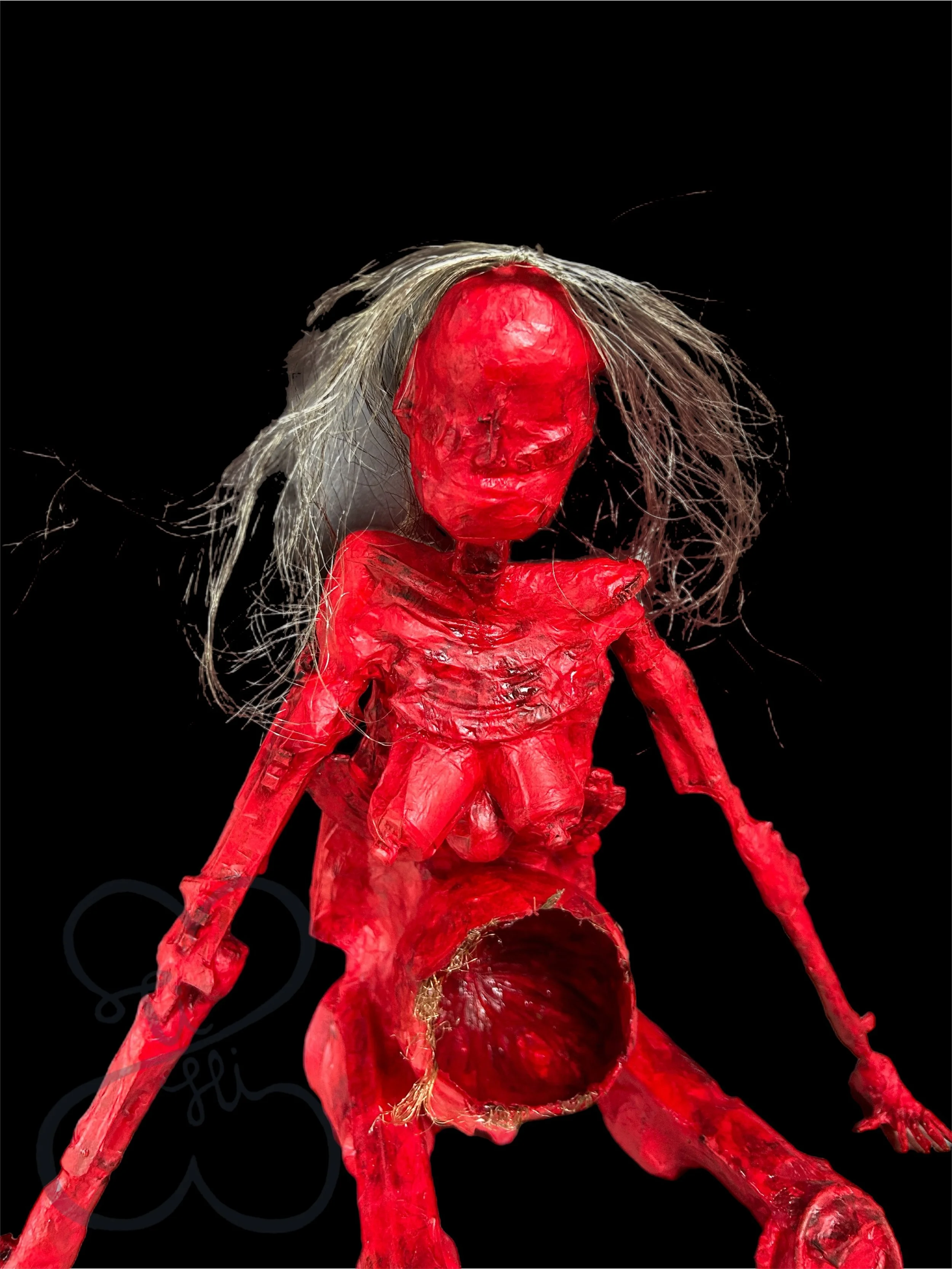
It was hard to make it not look like cloth, but I was happy with the result. She looked depleted. She looked as if her essence had been sucked out of her. I left one of her boobs hanging out as her body wasn’t caring about dignity anymore - a feeling any mother who has breastfed in public can relate to. I was very pleased with the result.
It took a while to dry, so I worked on some abstract pieces using the same techniques while I waited. I enjoyed the process so much that I was looking for excuses to work on it. I resented being asked to do anything other than make my sculptures. That’s when I know it’s good. I even imagined submitting my work to a gallery; one that might celebrate women or menopause. I looked a few up. The work they were exhibiting looked beige and overly quilted to me. Where was the blood-boiling red flesh?
A week passed. I showed a picture of the woman and the red abstract ball I was working on to friends. They said it looked “periody” or “intense”. The raised eyebrows horrified me. I knew I wouldn’t be able to put her on a pedestal in any gallery. When we look at women and blood, we think of periods, not life or energy or rage. When I looked at the sculptures again, I didn’t like them. The woman looked like an Egyptian mummy. The first abstract piece looked revolting.
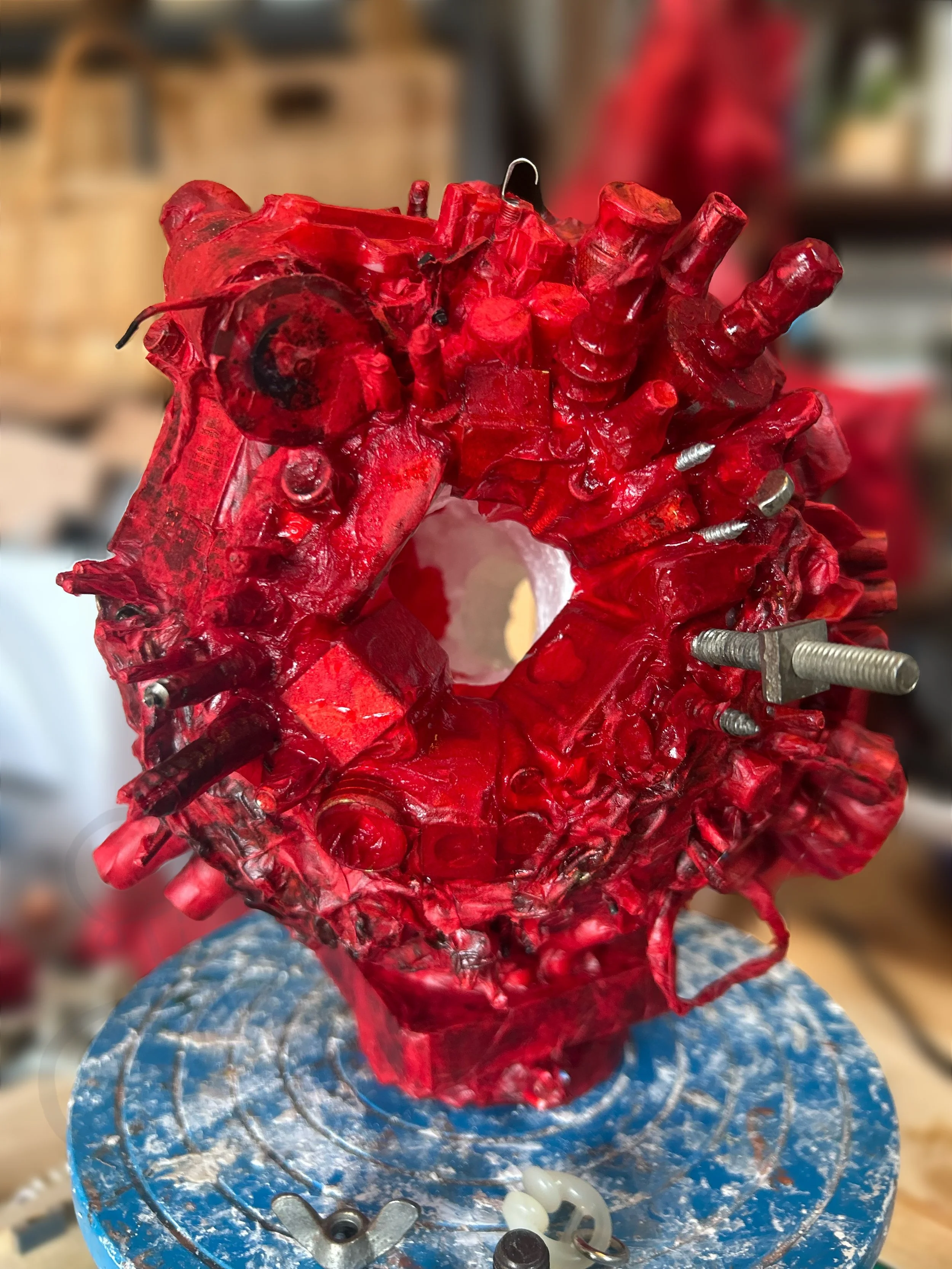
So I did what any sane woman would do. I stripped all the muslin off the woman and the red tissue paper off the abstract work. Halfway through ripping the muslin off the woman, I realised it looked like her skin had been flayed. I took a picture thinking it looked great, but continued to rip it all off. I now had a pile of ripped muslin pieces contaminated with red tissue paper that looked like a pile of flayed skinn. I washed them.
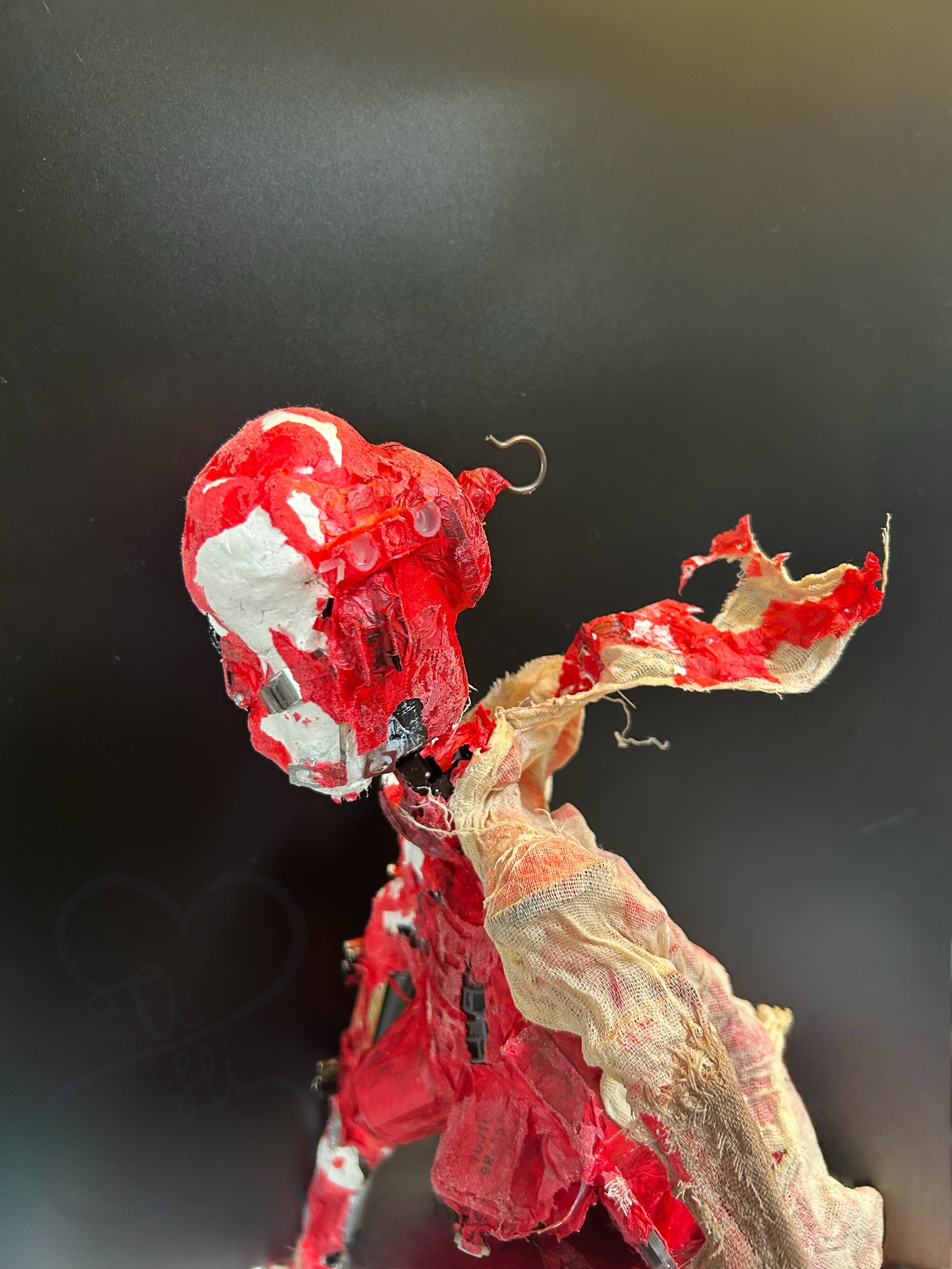
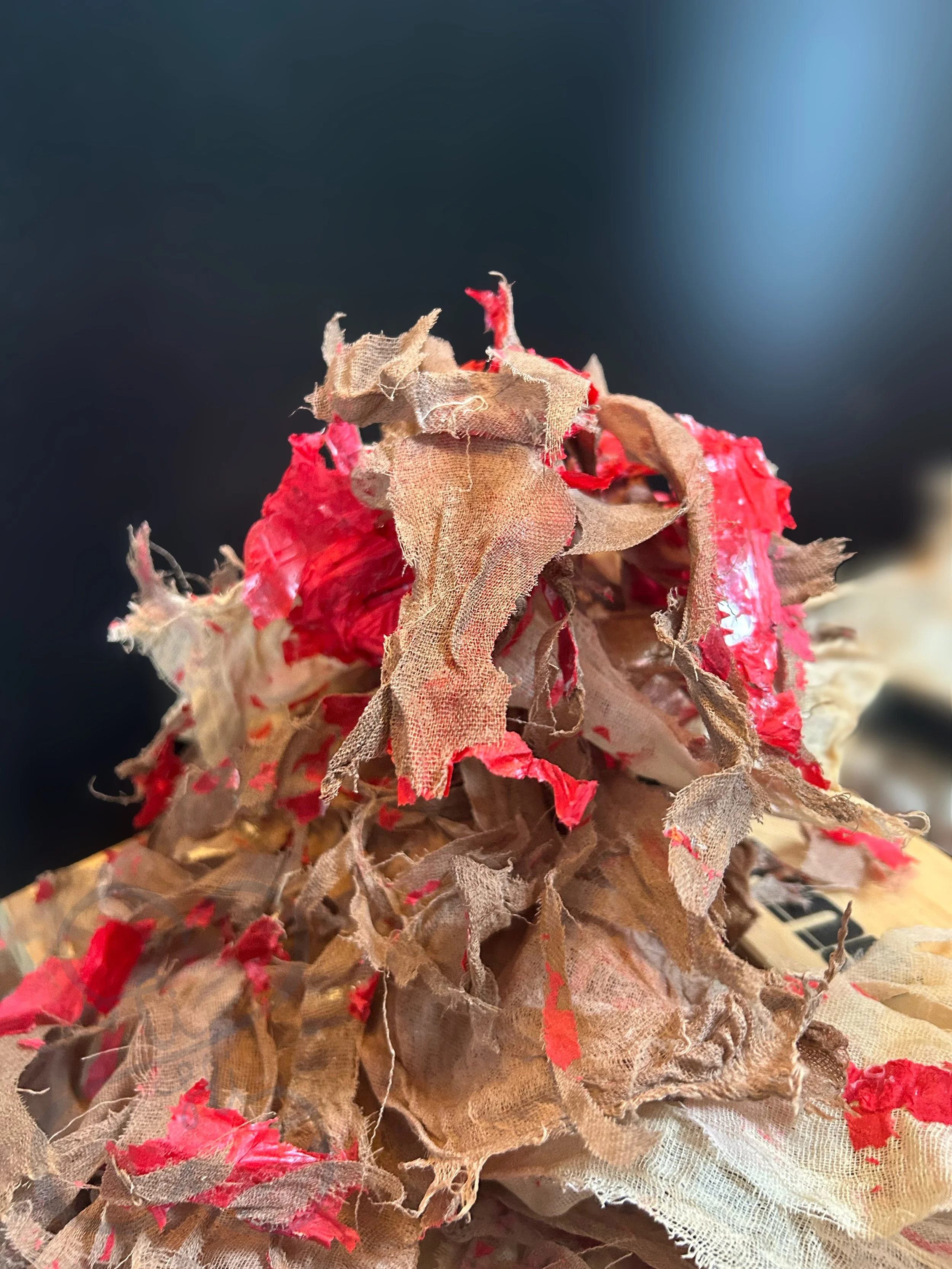
I redid all the red tissue paper. I realised I should have left her with flaying skin when it was too late. Then I melted the polystyrene ball. I couldn’t wait to see what the void would look like.
It looked like her abdomen was a crazy loud mouth monster, with the boobs for eyes.
I hated it.
I reworked the abstract pieces - gluing screws to another polystyrene ball and all the leftover electrical components to another. I like them more without the red. I photographed them and manipulated the photos on my iPad using a variety of apps and filters. I enjoyed the process.
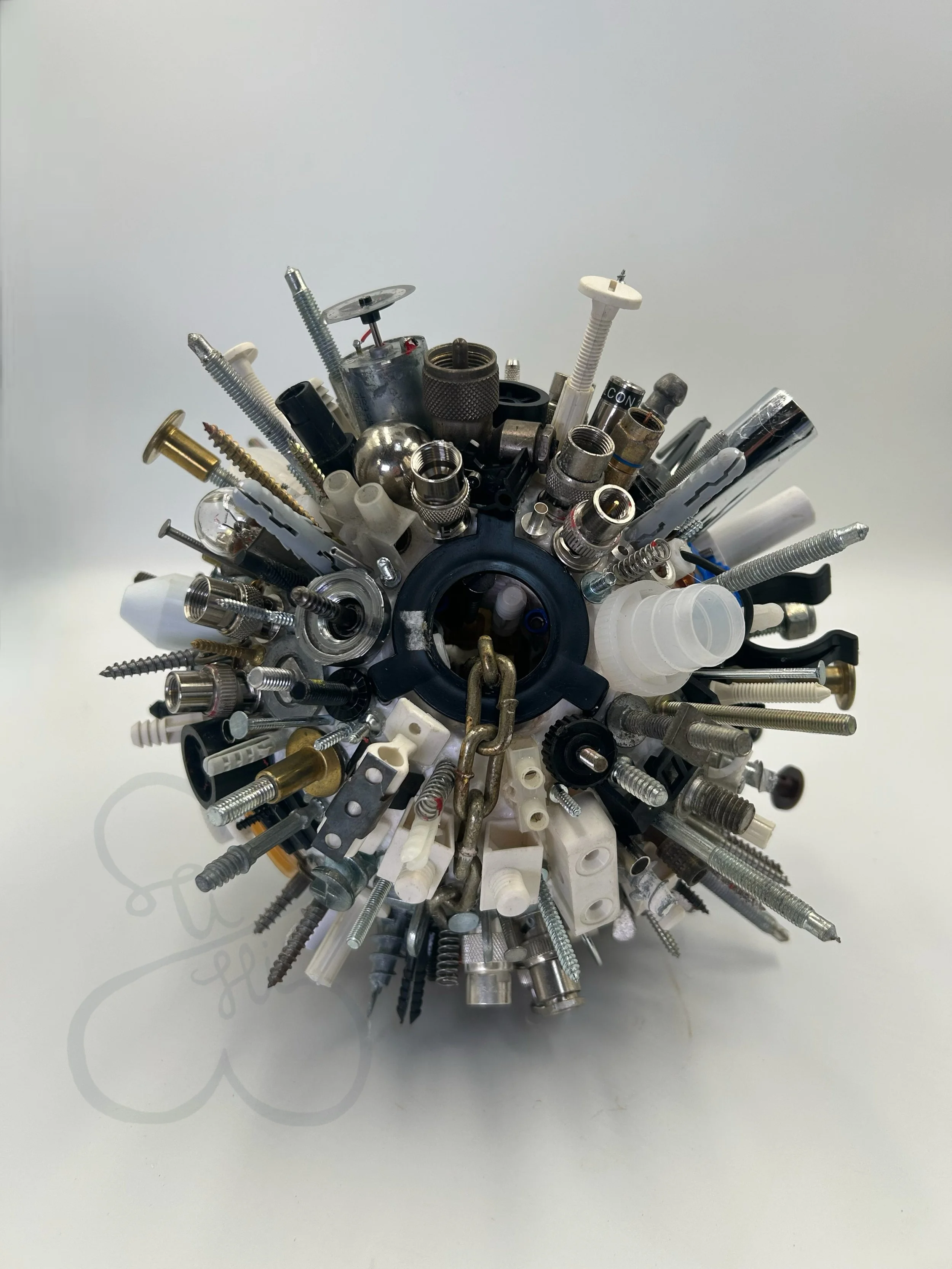
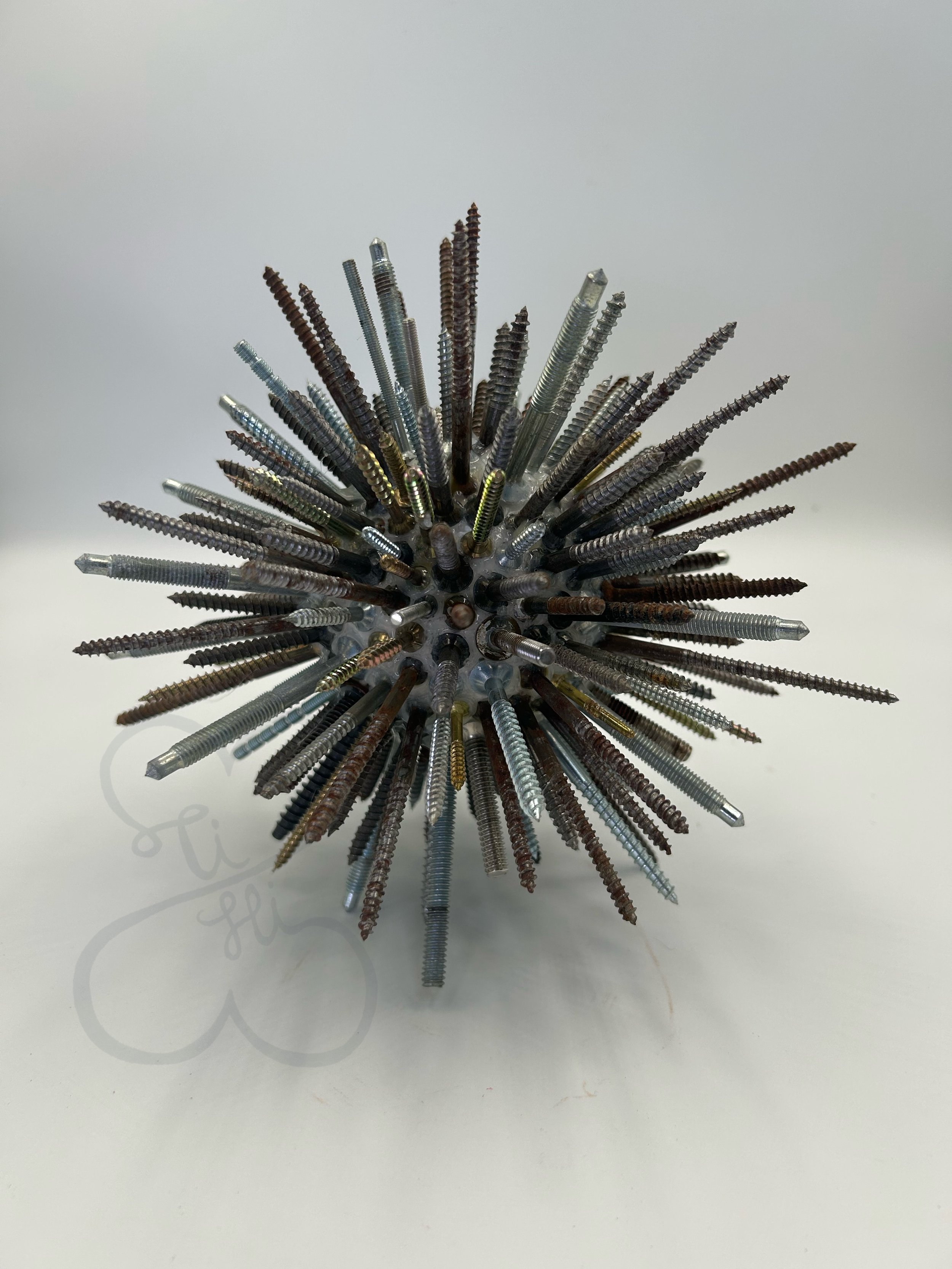
I now look at the woman differently. She still represents how I feel: too repulsive to look at. No one wants to see the rage, the void, or the pain. The only way a menopausal woman is going to be paraded on a t-shirt or a mug - the new billboards and galleries - is to be compliant and pleasant to look at.
Nothing has changed in this world.
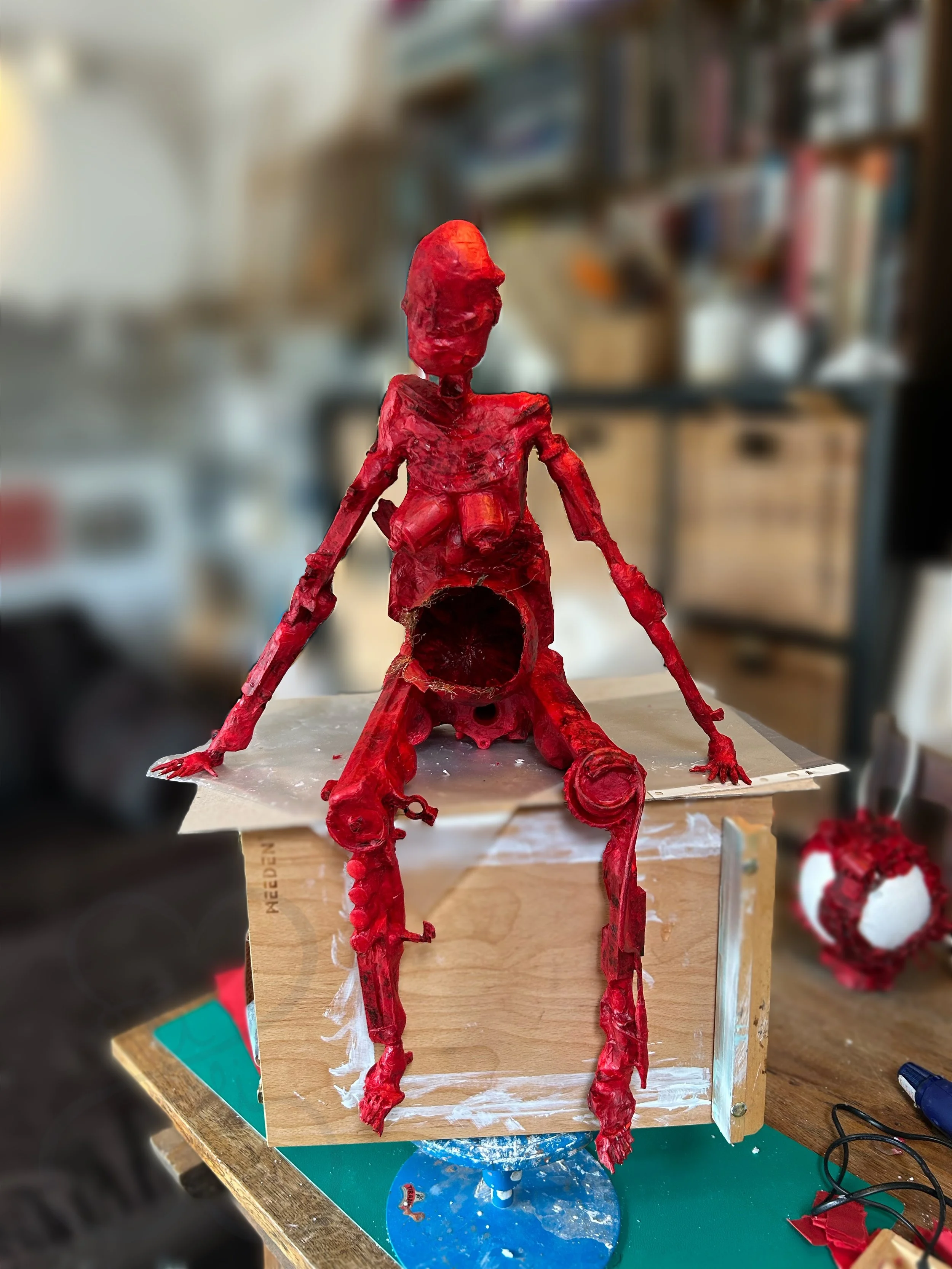
However, I have changed. The process of making the woman has changed me. It made me accept what I was going through. I was once diagnosed by a health practitioner by showing her a photo of a sculpture I had just made back in my early twenties. All I created was an updated version of that. My sculptures are visual diaries of my feelings when words fail. They don’t need to go in a gallery - thank god, I can’t lie or arse lick! They don’t need to be sold; they don’t need to do anything other than be created and then stare back at me. They have served their purpose. She can continue to swing her legs over the wall until I need her again.
I am wondering now as I write this: is there a part of this sculpture that represents my grief too? The rawness of my emotions has only reached its peak this year after losing my mother. It is not just a coincidence that I used her muslin to wrap around me. I have kept the muslin by the way; it will get used again. I am angry and in pain. I have lost the one that held me inside that void.
I was consumed by emotion when I made this sculpture. The emotions didn’t feel the same a week later; they had been expunged. I don’t feel better, but I feel more aware.